Essays
Short writings on various topics
On Generative AI
I've spent some time now thinking about chatbots like Claude and Codex, particularly on the people around me that are for and against it. With it's rapid advancement (and now industry-standard use case in the field I'm in), the existence of AI chatbots has pushed me to reevaluate my interest in even staying in my field. There are several stances one could take, and from many perspectives. I believe part of the issue lies in the fundamental disagreement on what the core topic may even be. After all, epistemic responsibility regarding this technology is hard to maintain in a space where people have different understandings of what generative AI is, with some just referring to it under the incredibly vague term of "artificial intelligence". When does it stop being an LLM generated feedback and start being a buzzword? This often crosses my mind when I have conversations with people regarding LLMs.
Different disciplines in both academia and the workforce have a variety of perspectives. A software developer may have a huge advantage to generating supplemental code/advice; I've found that some my peers in this field find absolutely no ethical problems with it. An overwhelming majority of my peers in this field are proponents for gen AI usage for helping them code, stating that it's necessary in current times. In more humanities related fields, I find that my peers heavily look down on all AI usage in general. Though I have a small network that is not representative of the larger world, this is the space I find myself navigating through. I wanted to reason out that generative AI is ethical for coding, but not for art and writing. How else could one use AI without shame?
It's easy to have an opinion, and perhaps easier to treat it as a rational fact and self righteously look down on other opinions. When you trust an opinion, you would want to believe that it is the "correct" belief. It's when you dismiss others to affirm your belief that curiosity and understanding of others decline. I think one thing that people should consider is that younger generations will live in an already AI inclusive world. It's dishonest to blindly all AI usage when it is becoming increasingly more difficult to navigate life without it, whether by choice or by circumstance. Many anti-AI people hold their stance against genAI for many reasons, from ethical to environmental concerns. In a conversation with a close friend, we talked about how it's impossible and almost useless to avoid AI altogether, so the next best course would be to use it "correctly". In a broad sense, situations of overreliance and replacement would be an "incorrect" way to utilize chatbots.
This is not to absolve myself from seeming like a virtuous individual. I make assumptions and get angry at reckless AI usage. I often want to resort to hate and pity when I see it being used to commodify culture and entertainment. However, we have a human obligation to judge in a denotative sense, to create a shared world of understanding. Keeping ourselves in strictly anti-AI bubbles lead to atomization, pushing ourselves from others unnecessarily when we should there for others.
Pavane [2026]
Pavane for a Dead Princess (2009) by Park Mingyu is one of the few novels that have taken place in my mind years after the first read. Park Mingyu delivers intricate imagery that immerses the reader in the story, following Lee Kyeongrok's budding and complex romance with Kim Mijung, an ostracized employee at the department store they both work at. It wasn't until I saw a video clip featuring Byun Yohan with a similar synopsis, that I found out that it was from Pavane (2026), a film adaptation by Lee Jongpil that had come out this month! Without revealing spoilers, I wanted to give my thoughts on the adaptation and review it with the context of the novel.
I am most familiar with the English translation of Pavane for a Dead Princess translated by Amber Hyun Jung Kim, which I will be referencing. The novel has a more direct critique of contemporary Korean society and lookism, delving each character's loneliness and change through friendship. Lee Kyeongrok (Moon Sangmin) is a new part-time employee that attracts attention for his "matinee-idol good looks", Kim Mijung (Go Ahsung) is a character that is bullied by her coworkers because of her appearance despite her skills, and Park Yohan (Byun Yohan) is a employee notorious for having a care-free personality. The story plays with the idea of the cinderella trope through these characters with the consequences of the real world and complex emotions.
With the time constraints of a film, I wasn't sure what to expect with the development of the story. The film's message focuses more on the interpersonal relationships between the characters. Some of the story was condensed and changed, such as changing the time period from the mid 80s to the present day. I felt that this was a sensible decision as the issues of superficiality and consumerism are just as topical. Rather than relying on dialogue, I found that the film had the most impact when using visual storytelling to express the characters emotions. There's a unique charm in the careful scene compositions that captures the immerse acting of the characters as they navigate young adulthood.
The set design was the aspect of the film that I was anticipating the most, and production did not let me down. The prose describing the various environments is grounded and detailed, often taking time to point out specific amenities that make the places unique. This was perfectly translated into the physical construction of the locations, and the attention to detail didn't go unnoticed. It was surprising how accurate the film's set design matched my imagination, a testament to the author's unique voice and detail.
The film truly shines with the refreshing and natural scenes accompanied with the soundtrack. Pieces by Maurice Ravel and Émile Waldteufel are featured and create a dreamy ambience that fits the mood of the unspoken moments. I'm very biased as Pavane pour une infante défunte is a personal favorite of mine, but it fits the nostalgic message of the film and its appreciation for youth and memories of the past. Though a novel doesn't come with the auditory advantage that a movie utilizes, Park Mingyu also references multiple artists in the novel; though I'm unsure if this is just in the translated version, the additional blurbs in the footnotes add character to the internal monologues.
Although it's not a perfect film, I felt that the adaptation did a good job expressing the complex emotions without trying to be overly faithful to the novel. In an age where remake movies and adaptations are attacked by being compared to their literary counterparts, Pavane approaches the story in a unique way by using the strengths of its medium. I would recommend a watch if you like slow romances and pretty scene compositions, and I would doubly recommend the novel you want a better grasp of the characters and social commentary.
A life without speech and without action
is one that is not lived among humans. Arendt explicates the "who" of a human as not the traits or physicality, but the identity of an individual as it appears to others through action. It has been a while since I have analyzed her work thus my writing is not meant to be representative of her opinions. Instead, I am looking back at my annotations to reevaluate some philosophical concerns in the context of my daily routine. I find myself wondering how I can act in a time in my life where I am somewhat isolated. It's easier now to fall in the cycle of consumption of the kitsch. Natality as a beginning for action -> introducing a new capacity for establishing relationships- this broad concept always brought comfort to myself when I moved to different countries. I feel as if I am in a state of limbo because I have not entered a new environment, only having left one. This may be how I personally feel, but Arendt suggests the value of solitude as a space to leave the public realm to resist the threat of conformity; a new perspective that is also comforting.
notes on web dev
Two and a half years ago I started this website because I wanted to create a space to document my hobbies and play around with html. Alongside creativity, it's been a great way to learn about internet responsibility, ownership, and quality of life additions (things like maintaining a good user experience and safely using resources). I wanted to share some of the things I learned that wasn't clear to me when I first started web development.
Creating an accessible interface is a huge bonus to a website if it is intended for many viewers. With unlimited design options, I often get carried away with the visuals of my site. I found that finding a balance between both works best with the intentions of my website as a creative outlet and a blog. Ensuring your website is designed with accessibility in mind can make formatting cleaner. Using rem over px for font size is recommended because it can make editing font size much easier and cohesive. Rather than remembering a specific px size, you can set 1rem as the base size in the root of your css file and adjust from there. Adding alt text to images helps to describe images to screen readers and devices that fail to load images, but I also find it helpful when I am navigating my poorly named files so I know which image is which without having to open the file. While accessibility may not be the exigence for your project, accessible design helps everyone.
Paid fonts come with licensing restrictions, but so can free fonts too! It can be tempting to jump straight to uploading fonts to a folder and use @font-face to implement them. However, while many fonts allow for web usage, self hosting may violate their licensing terms. Due to the insecure nature of websites, complete protection of font files is not guaranteed. If using custom typography, first check if you can use the fonts from a provided API on the site before self hosting (if allowed). I recommend crediting the creators for their work even if not mandatory.
My favorite movie (spoilers)
Watching Tekkonkinkreet, the most visible conflict of gentrification. Unable to go back to the same environment from my childhood, whether it be through gentrification or physical distance, I strongly resonated with Kuro's sense of
entitlement and stubbornness to protect 'his' town. I felt a familiar connection of holding onto past paraphanelia and the value the ideas hold.
One scene that particularly stood out was the clear distinction between Shiro and the educated children in school. They aren't able to
fly like he does, but they likely won't be hurt much by the amusement park that would be built. It's a cruel irony that the gentrification
of the town by building an amusement park, meant for kids, would exclude them. Of all the dialogue in the film, the characters repeatedly emphasize
that they are just children, even those who are humbled by them. Shiro, Kuro, and their beloved community will all be affected by these physical
changes to their environment. It will eventually exclude them entirely, as seen with Kuro's dialogue with the amusement park employee.
The main antagonist Ebi was a well written character, despite talking in the shadows of the more interesting characters. However, this makes more
sense for him because of how replacable he is. There is no distinctive motivator besides monetary gain. The very fact that he and his goons are
replacable fits with the working cogs of the capitalistic mindset that the film is against. As Ebi himself claims, the damages that Kuro caused
are replacable, as it was created to be.
The catharsis that the minotaur brings invites the audience into the perspective of Kuro perfectly, as we feel relief that the physical threat
is gone. However, the story makes it clear that this uncontrolled apathy for the world is not a belief system that is balanced.
We feel the pull still, and that's what makes the threat so real and unpredictable despite common narrative tropes directing us towards a happy ending.
On a more light hearted note this film involves mobsters which is always a welcome element in my movie watching experience. I thoroughly enjoyed
predicting themes that would be explored, and the payoff when they would fulfill or subvert my expectations.
Gundam Thunderbolt
Story
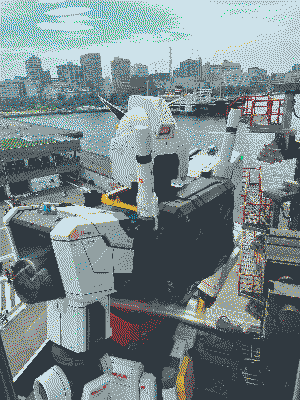
While the franchise as a whole handles topics like war and geopolitical tensions, Thunderbolt takes itself a bit more seriously albeit in a different way. The dichotomy between Io and Daryl is one of the central themes that's explored, most explicitly shown in their music taste.
Mobile Suits
The mobile suits in Gundam Thunderbolt expand on the traditional Gundam and Zaku designs like many other entries in the franchise. While not shown in the show, I like the overexaggerated weapons that the Ver. Ka models dilate. The Psycho Zaku Ver. Ka in particular is an anticipated purchase for the future.
Soundtrack
I first came across Thunderbolt through its freeform jazz, which was not expected from the franchise. I was slowly gaining affinity for some tracks from Zeta and Origins, but the entire soundtrack from Thunderbolt season 1 is a no-skip album for me. Both the jazz and easy-listening tracks are tasteful and elevated the listening experience of the show for me. I've explore more of Naruyoshi Kikuchi and friends' work thanks to this discovery.
The clear direction of the season 1 soundtrack built anticipation for my first viewing of season 2. I have my own copy of the season 2 sountrack cd, but I felt that it didn't live up to the quality of the original soundtrack. The jazz tracks were as exciting as the first soundtrack, but the mainstream pop-inspired ones interpolates many existing works that honestly borders plagiarism.
Love Letter to the DS
Growing up with Nintendo games, book style DS games have always had a special place in my heart.
Rhythm Heaven
Rhythm Heaven was one of the first video games I was exposed to as a child, and it's played a large influence in my musical and cultural consumption. The book style "gimmick" worked perfectly with the ds game, and I spent hours grinding levels to get perfect scores and unlock mini games. I was drawn to the cheerful characters and catchy songs, and the satisfaction of having perfect rhythm in my gameplay catalyzed the start of my rhythm game journey. One of my favorite levels was the fanclub monkeys because of the song and silly concept.
Brain Age
My most used console from my childhood was the DSi XL, which came with the brain age express series. All of my games were on cartridges as I did not buy any games digitally, which meant that brain age express was often the only other alternative series I could play. Fortunately, I loved spelling and art! I enjoyed comparing my artworks with friends and family as a fun competition.
Hotel Dusk
Wishing to play a Shu Takumi directed game, I looked into buying ghost trick which I quickly abandoned due to its resale price [prior to the remaster]. I picked up a copy of hotel dusk instead, and sparked my love of ds games again. While the gameplay and story has its flaws (difficulty of progression and puzzles), the extremely charismatic dialogue is unlike any other game I have played. I also enjoyed the artwork of Taisuke Kanasaki, whose rotoscoping direction only added to the uniqueness. Although I was not able to fully enjoy the games from Cing INC. as much (namely trace memory), the quirks of the book style puzzles leaves a charming impression.
conspicuous consumption and emotional literacy
In recent years, I have began to see an spreading pattern of consumerism that has been prevalent in my community and within myself, an phenomenon and ideology that goes against my philosophies.
Veblen’s examination of the leisure class details the precedence that allows for the phenomenon of conspicuous consumption and how reputability pertains differently to various classes, which has evolved with the development of globalization and social networking systems in particular. Leisure life is a display formed by the disposable wealth combined with the conformed etiquette that is associated with leisurely activities. It's been more accessible than ever to partake in small aspects of this lifestyle, and often even easier to display them publicly for anyone to see. There is a specific way adapting to the aesthetic faculty that requires time and application, further contributing to the reputability and maintenance of "nobility" in society. This can be translated into the modern day to demonstrate class and attract attention as a capstone of accomplishment. Conspicuous consumption is noted to be most effective where there is the most human contact; this could potentially explain the exacerbation of densely populated social networking systems used as a form of digital environment for which this display takes place. Veblen also explains the roots of conspicuous consumption to have a strong connection with the patriarchal tradition, as the characterization of the leisure class was often a symbol of honor associated with hierarchy. Along with the products and activities that are consumed for the purpose of displaying wealth consciously and subconsciously, the behavior in turn becomes sophisticated and honorific in society due to its exclusivity. I could name a myriad of products which people frenzy over online in digital spaces, many of which serve mainly vain and connotative purposes. Although the cultural and emotional impact may be authentic and bring value, it is important to acknowledge the exploitation of this phenomenon and prevent immoderate consumerist patterns.
Emotional Exploitations: Clemens Thornquist
Thornquist’s exploration into the design of products with Veblen’s idea of conspicuous consumption in mind focuses on the emotional aspect of purchase and acquisition for consumer goods. Using extreme behaviors, Thornquist examines the emotional drive behind conspicuous consumption. Behaviors such as impulsive and compulsive buying are used as opportunities for marketing. Branding strategies targeting demographics with low self esteem use status as a selling point for products; the fashion industry has an edge in marketing due to the nature of fashion's constant outward appearance. This behavior is magnified in the context of digital shopping, where scrolling on websites and one tap purchases makes for easy access. Another unethical aspect to include is the emotional conditions that are exploited for marketing to attract consumers. One idea regarding image construction is the suggestion that branding strategies are more successful in consumer cultures with a lower level of economic development. In particular, Thornquist makes a connection to pecuniary emulation and cases in which consumers prefer branding due to the status and reputation it may confer. Basic examples may include faulty copies of luxury products being sold globally despite the indifference in quality with non-branded products. Thornquist also explores the in-depth connection between anxiety and compulsive buying within the context of larger consumption habits. The “beauty myth” and other identity concerns catalyze compulsive buying behavior as a form of escapism, providing temporal pleasure at the cost of long-term negativity. Though there are no clear solutions, making conscious decisions to decrease emotional attatchment to the design and aesthetic of products can prevent habits that are encouraged by underhanded corporations and industries.
Digital Society: Xu, Chonghuan, et al.
This study explores the influence of cyber-ostracism in social media on the drive behind conspicuous consumption and the acquisition for control. Social media is the main medium that was used to determine one’s online presence and their behavior resulting from social exclusion due to the lack of positive feedback or too much exposure to other peoples’ information. The researchers regard social media as a new platform that has the capability to foster social exclusion in online technology, deriving from real social exclusion in person. Individuals with an increased presence on social media tended to compare themselves to their digital environment, a theme explored in Veblen’s definition of invidious comparison. Thus, the resulting low self esteem and perceived lack of control was a large part in influencing conspicuous consumption. In particular, the paper often mentioned the compensatory control theory as a reacting behavior to social isolation online; Individuals felt a need to compensate their negative emotions through purchases that sought to increase social status and name recognition from other peers. Another notable point explored was the symbol of unique luxury goods within the context of conspicuous consumption. Individuals will feel more inclined to purchase conspicuous luxury goods because they are differentiated from the majority may be more effective in receiving social recognition. A variable that is not explored in this study is the reputation of certain luxury goods within the context of some popular culture niches, notably in fashion. While unique goods are noted to be attractive to individuals that have experienced cyber-ostracism, the motivation behind the purchase of gimmicky and satirical luxury products are not differentiated from luxury products that are conventionally desirable in the study.
When associating an item to the word 'luxury', you may confront an image of a high-end bag or outfit that is plastered in branding and prominent logos. With the increasing recognition that some brands receive, trends come and go, dating these brands with a time period of the past. The exclusive aspect of conspicuous consumption has somewhat evolved to something more inconspicuous, meant to attract a smaller demographic that show an implied lifestyle of being an insider of a niche community with an air of elitism. There is a certain hostility that individuals may be met with, by the assumption that they are intentionally navigating the social environment through the means of pecuniary emulation. It is an expectation-filled lens in which people are viewed with, intensified by the barrier to the whole individual placed by social networking systems and intentional care for the aesthetic. This immediate hostility could be a projection of those who mean to protect their identity, which brings to question the authenticity of displaying these lifestyles online. Is the solution to completely disregard social media and public display of interests? While that may unfold these perspectives and feelings of low self esteem, distancing ourselves from the ways in which this display of leisure lifestyle not only consumes our wallets but our minds can also bring a healthier outlook towards our relationships with products and the world around us.
sources:
Thorstein Veblen. "Conspicuous Consumption."
Chapter 4 in The Theory of the Leisure Class: An Economic Study of Institutions.
Thornquist, Clemens. “Unemotional Design: An Alternative Approach to Sustainable Design.”
Design Issues, vol. 33, no. 4, Oct. 2017, pp. 83–91.
Xu, Chonghuan, et al. “Is Conspicuous Consumption Influenced by Cyber-Ostracism? A Moderated Mediation Model.”
Behavioral Sciences (2076-328X), vol. 13, no. 1